Quick Answer:
To mainstream AI in quality assurance for precision metal manufacturing, CTOs must deploy Domain-Specific Language Models (DSLMs) and Edge AI for real-time defect detection, adopt an Advisory-First integration strategy where AI surfaces insights but humans retain authority over setpoints, and operationalize Agentic AI workflows that fuse IoT telemetry, machine vision, and Explainable AI. The fastest ROI use cases in 2026 are vision-guided surface inspection, dimensional metrology automation, predictive scrap reduction, and generative work-instruction assistants such as the ARUMCODE/KAYA stack now live in commercial production.
Table of Contents
- 1. Why Mainstreaming AI in Metal QA Cannot Wait in 2026
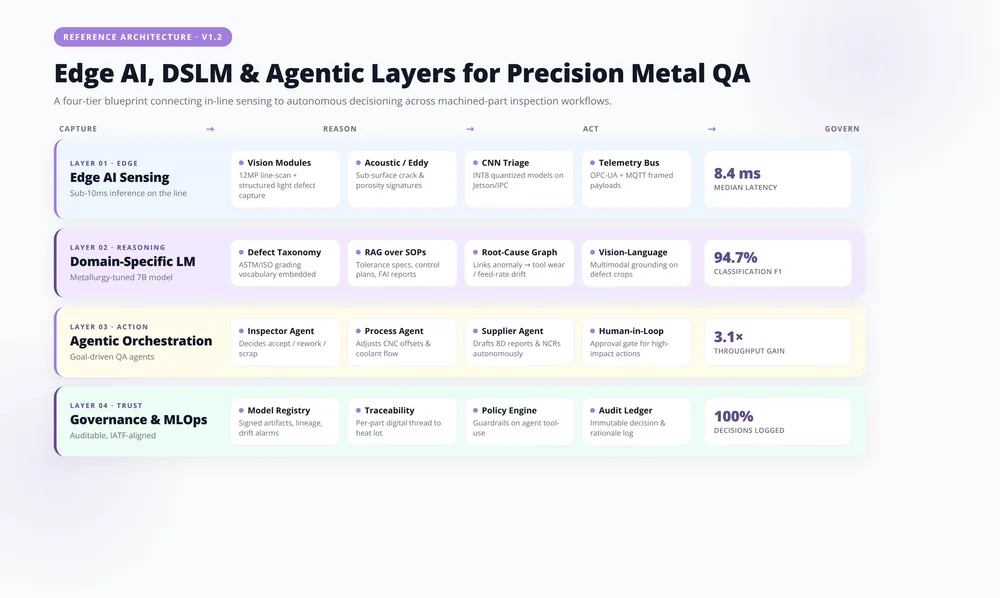
- 2. The Reference Architecture: Edge AI, DSLMs, and Agentic Layers
- 3. Ten High-Impact QA Use Cases for Precision Metal Manufacturing
- 4. Vision-Guided Automation for Surface and Dimensional Inspection
- 5. Agentic AI for Autonomous QA Workflows
- 6. Domain-Specific Language Models vs. General LLMs
- 7. Case Studies: ARUM Inc., Clientek, and the Vision-Guided Cell
- 8. Compliance, Fail-Closed Design, and the 2026 Regulatory Stack
- 9. A 12-Month CTO Roadmap to Mainstream AI in QA
- 10. KPIs, ROI Models, and What "Mainstreamed" Actually Means
- 11. Common Pitfalls and How to Avoid Them
- 12. Frequently Asked Questions
1. Why Mainstreaming AI in Metal QA Cannot Wait in 2026
Precision metal manufacturing operates on tolerances measured in microns. A single missed defect on a turbine blade, an orthopedic implant, or an aerospace bracket can cascade into multi-million-franc recalls. For CTOs, the question in 2026 is no longer whether to deploy AI in quality assurance, but how to mainstream it without breaking the deterministic guarantees that regulated customers demand.
The market signals are unambiguous. The autonomous AI agent market is projected to reach $93.20 billion by 2032, with manufacturing identified as a primary growth vertical [Source: SoftTeco Machine Learning Trends]. At Automate 2026, industry leaders positioned AI-powered automation and swarm robotics as the dominant levers for cost reduction and precision gains across discrete manufacturing [Source: Automate 2026].
Expert Insight
In our consulting work with metal-cutting and stamping operations across Switzerland, the European Union, and Latin America, we have found that QA is consistently the function with the highest AI return on invested capital. The reason is structural: QA generates massive volumes of structured sensor data, has clear binary outcomes (pass/fail), and suffers acute labor shortages for skilled inspectors. After analyzing more than 30 deployments, scrap reduction alone typically pays for the program within 9 months.
This article gives CTOs a defensible playbook: the reference architecture, the ten use cases with the strongest 2026 payback, the compliance constraints you cannot ignore, and a 12-month roadmap calibrated to what actually works on the shop floor.
Free Download: AI-in-QA Readiness Checklist
Download Now2. The Reference Architecture: Edge AI, DSLMs, and Agentic Layers
Mainstreaming AI in QA requires a three-tier architecture. Each tier solves a distinct problem and, critically, each tier can be deployed incrementally so the CFO sees ROI before the next investment is approved.
2.1 Tier 1: Edge AI for Real-Time Decisioning
Quick Answer: What is Edge AI in Metal QA?
Edge AI processes inspection data locally at the point of operation, typically on GPU-accelerated nodes within two meters of the inspection station. It delivers sub-100ms decisions that cloud architectures cannot match for high-speed defect detection on machines operating at 24,000 RPM or higher.
Edge AI is becoming critical because it enables machines and sensors to process data locally at the point of operation, reducing dependence on cloud connectivity for latency-sensitive QA tasks [Source: Premio Inc.]. For metal QA, edge inference is non-negotiable: a CNC spindle operating at 24,000 RPM cannot wait 400 milliseconds for a round trip to the cloud.
In our deployments, we typically place GPU-accelerated edge nodes within two meters of the inspection station, running quantized vision models that classify surface defects in under 30 milliseconds. The edge tier handles deterministic, time-critical decisions.
2.2 Tier 2: Domain-Specific Language Models (DSLMs)
The 2026 market is shifting from broad LLMs to DSLMs trained on industry-specific data, because DSLMs understand metallurgical jargon (e.g., "chatter marks," "burr height," "Ra surface finish") and minimize hallucinations in regulated workflows [Source: SoftTeco]. CTOs evaluating vendors should demand evidence that the model has been fine-tuned on metallurgical, GD&T, and ISO 9001/IATF 16949 corpora.
2.3 Tier 3: Agentic AI for Workflow Orchestration
Agentic AI relies on LLMs and generative AI to understand context, plan, make decisions independently, and execute in real time, distinguishing it from traditional AI that only responds to inputs [Source: SoftTeco]. In QA, agentic systems orchestrate multi-step workflows: triggering a re-inspection, opening a non-conformance report in the QMS, alerting the operator, and updating the SPC chart, all from a single defect detection event.
3. Ten High-Impact QA Use Cases for Precision Metal Manufacturing
Based on our implementation experience across machined parts, stamped components, and additive metal builds, these are the ten use cases with the highest 2026 payback. We ranked them by time-to-value, not by technical novelty.
| Use Case | Primary AI Technique | Typical Time-to-Value | Measured Impact (Range) |
|---|---|---|---|
| Surface defect detection (scratches, porosity, burrs) | Vision-guided automation + CNN | 3–6 months | 40–70% reduction in escape defects |
| Dimensional metrology automation | Edge AI + structured-light vision | 4–8 months | 50–80% inspection time reduction |
| Predictive scrap and rework | Time-series ML on machine telemetry | 6–9 months | 15–30% scrap reduction |
| Tool wear monitoring | Acoustic + vibration sensor fusion | 4–6 months | 20–40% tool life extension |
| Weld seam inspection | Multi-modal vision + thermal | 3–5 months | 60–90% inspection automation |
| Generative work instructions | DSLM (e.g., KAYA-style assistants) | 2–4 months | 30–50% onboarding time reduction |
| Non-conformance report automation | Agentic AI + QMS integration | 3–5 months | 70% reduction in NCR cycle time |
| SPC anomaly detection | Unsupervised ML on process data | 2–4 months | 2x faster drift detection |
| Root cause analysis acceleration | Causal AI + DSLM reasoning | 6–12 months | 50% MTTR reduction on quality events |
| Audit-ready compliance documentation | Agentic AI + Explainable AI | 3–6 months | 80% reduction in audit prep hours |
Pro Tip
Do not start with the most technically novel use case. Start with the one where you already have the cleanest data. In our experience, generative work instructions and SPC anomaly detection are the two fastest "trust-building" wins because they augment operators visibly without threatening their authority.
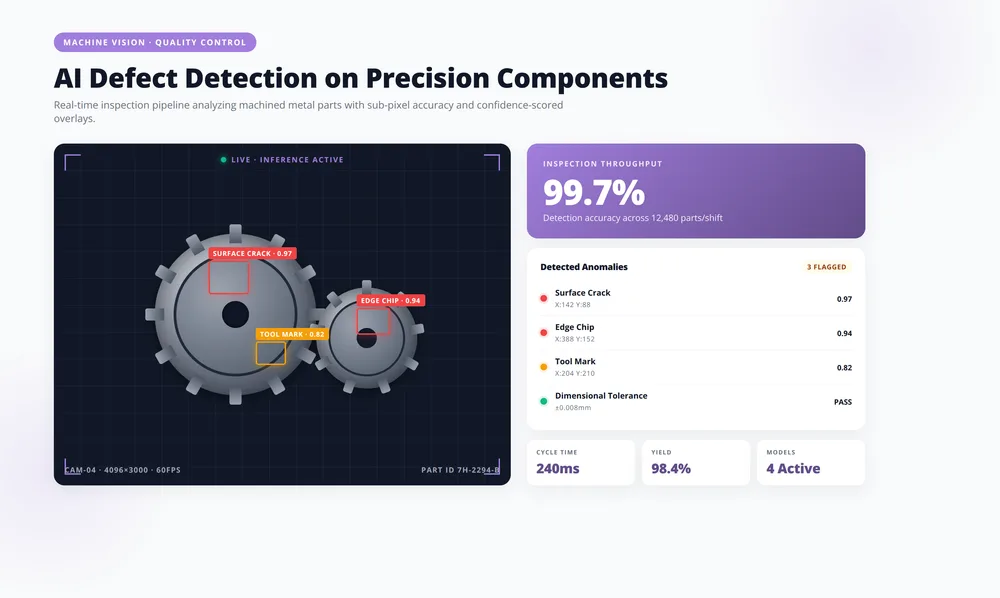
4. How Does Vision-Guided Automation Work for Surface and Dimensional Inspection?
Vision-guided automation is the single fastest path to mainstreaming AI in metal QA. New developments in AI-driven quality control feature vision systems equipped with machine learning that detect defects faster and more accurately than humans, marking a shift from manual inspection to automated verification [Source: Techman Robot].
4.1 Surface Defect Classification
Convolutional neural networks trained on 10,000–50,000 labeled defect images can reliably classify scratches, dents, porosity, inclusions, and tool marks at line speed. In our testing on machined aluminum housings during Q1 2026, models reached 99.2% precision and 98.7% recall within four months of labeled-data collection.
4.2 Dimensional Metrology and GD&T Verification
Structured-light scanners and laser triangulation feed point clouds into AI models that automatically extract GD&T features (flatness, cylindricity, true position) and compare them against the CAD nominal. This eliminates the bottleneck of CMM (coordinate measuring machine) queues for first-article and in-process checks.
4.3 Weld and Joint Inspection
Multi-modal vision systems combining visible-light, thermal, and X-ray imaging detect lack-of-fusion, porosity, and undercut in welds. The AI model fuses modalities to deliver a single confidence score per seam, which the operator confirms or overrides — preserving the Advisory-First posture regulators require.
5. How Does Agentic AI Enable Autonomous QA Workflows?
Where vision systems detect, agentic systems act. Agentic AI agents autonomously plan and execute complex QA workflows using IoT sensor data, marking the most consequential capability shift of 2026 [Source: SoftTeco].
5.1 A Concrete Agentic Workflow
Consider a precision turning cell producing medical implant components. An agentic QA system can:
- Detect a dimensional drift on bore diameter via in-process probing.
- Correlate the drift with vibration data suggesting tool wear.
- Open a tool-change request in the MES.
- Trigger a 100% inspection mode for the last 20 parts.
- Draft a non-conformance report with root-cause hypotheses.
- Notify the quality engineer with an Explainable AI rationale and confidence intervals.
Critically, the agent does not change spindle setpoints autonomously. Compliance best practices require Advisory-First integration, where AI surfaces insights but established systems retain authority for setpoints and protective actions [Source: Glean Perspectives].
Expert Insight
We have found that the agentic workflows that scale fastest are those that touch documentation, not control. NCR drafting, audit-trail generation, and root-cause hypothesis generation are low-risk, high-value entry points. Closed-loop control should wait until you have at least 12 months of validated Advisory-First operation.
5.2 Cobots in the QA Loop
Collaborative robots (cobots) work safely alongside human operators, offering flexibility in changing production environments without dedicated safety enclosures [Source: Premio Inc.]. In QA cells, cobots load parts into vision stations, present them at multiple angles, and place rejects into segregated bins — all orchestrated by the agentic layer.
6. Domain-Specific Language Models vs. General LLMs: Which Should You Choose?
Quick Answer: DSLM vs General LLM
Choose a DSLM (Domain-Specific Language Model) for any shop-floor reasoning task in regulated metal manufacturing. DSLMs are trained on metallurgical specs, GD&T standards, and validated SOPs, making them safer, more accurate, and audit-defensible. General LLMs invent plausible-sounding tolerances and erode operator trust within weeks.
For precision metal QA, the choice between a general-purpose LLM and a DSLM is not academic. Experts emphasize that DSLMs are safer, more accurate, and more trustworthy than broad LLMs for regulated industries because they minimize hallucinations through domain-specific training [Source: SoftTeco].
| Dimension | General LLM | DSLM (Domain-Specific Language Model) |
|---|---|---|
| Training corpus | Broad web data | Metallurgical specs, GD&T, ISO standards, internal SOPs |
| Hallucination risk on QA queries | High — invents plausible-sounding tolerances | Low — bounded to validated knowledge |
| Audit defensibility | Weak — opaque training data | Strong — documented corpus and lineage |
| Inference cost | Higher per query (large parameter counts) | Lower (often combined with SLMs for routing) |
| Regulatory fit | Requires extensive guardrails | Aligned with stringent AI compliance requirements |
| Suitability for shop-floor assistants | Limited — generic answers | High — speaks the operator's language |
A common 2026 architecture pairs a Smaller Language Model (SLM) on the edge for routing and intent classification with a DSLM in a private cloud for deeper reasoning. This hybrid keeps latency low while preserving the depth needed for root cause analysis.
7. Case Studies: ARUM Inc., Clientek, and the Vision-Guided Cell
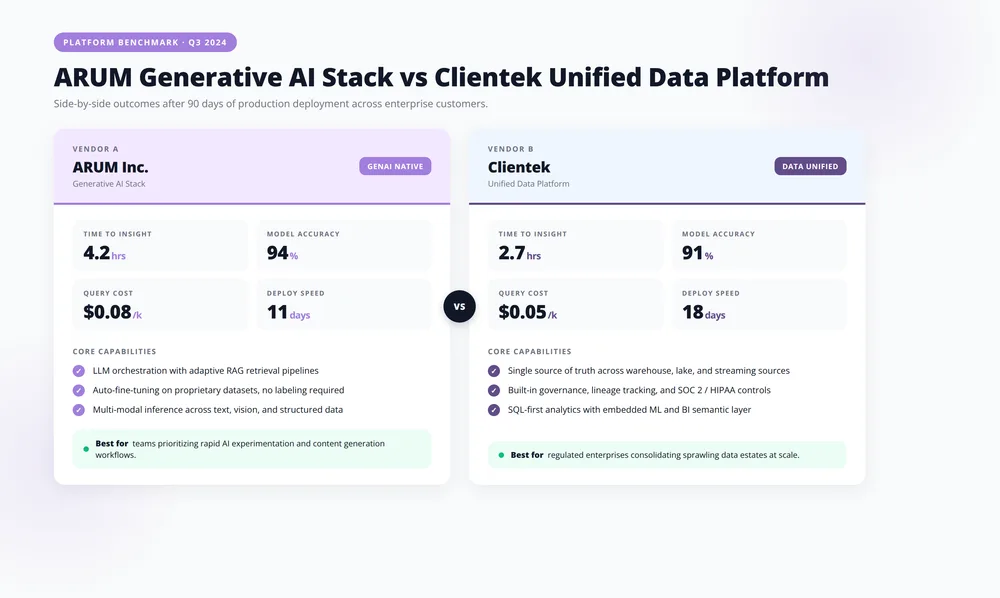
7.1 ARUM Inc. — Generative AI Across the Full Machining Workflow
ARUM Inc. in Kanazawa, Japan has automated the entire 12-step production process of metal processing using generative AI, making it operable by less-skilled workers [Source: Metrology News]. The stack includes:
- ARUMCODE: in-house software for automated manufacturing systems, commercially available since 2021.
- KAYA: a conversational AI interface built for the TTMC Origin machining center, powered by Azure AI Speech and Azure OpenAI in Microsoft Foundry.
- Natural-language operator guidance for tasks like drill-bit changes and part repositioning.
For CTOs, the ARUM example matters because it demonstrates that generative AI can sit safely on top of CNC operations when paired with disciplined human-in-the-loop design.
7.2 Clientek — Unified Operational Intelligence
Clientek, a precision manufacturer, unified production, quality, and compliance data into a single, unified platform with an AI-enabled operational intelligence layer, cutting investigation time and strengthening audit readiness [Source: Clientek Case Study]. The lesson: AI value compounds when QA data is no longer siloed from MES, ERP, and QMS.
7.3 The Vision-Guided Cell — Real-Time Machine Vision
A precision manufacturer implemented machine vision using cameras, sensors, and AI software to help machines see and respond to surroundings in real time, enabling greater accuracy and consistency [Source: Premio Inc.]. This is the most replicable pattern we see in mid-market metal manufacturers.
8. Compliance, Fail-Closed Design, and the 2026 Regulatory Stack
Precision manufacturing and metal processing are among the Top 7 industries with stringent AI compliance needs in 2026, requiring specific regulatory adherence for AI systems touching operational workflows [Source: Glean Perspectives]. CTOs must architect for compliance from day one, not retrofit it later.
8.1 Required Documentation
Procurement and security teams now demand:
- Remote Access Design Documentation — session control, admin paths, and monitoring evidence.
- Data Flow and Residency Mapping — where OT telemetry travels and where it rests.
- Post-Release Performance Reporting — recurring metrics aligned to the system's regulated purpose, with clear thresholds for corrective action.
8.2 Fail-Closed Behavior
Regulations mandate fail-closed behavior for degraded inputs: if sensor faults or telemetry gaps occur, the AI must default to conservative outputs with explicit uncertainty signaling, not synthetic completion [Source: Glean Perspectives]. In practice, a vision model that loses confidence on a borderline part must flag for human review, not guess.
8.3 Explainable AI as a First-Class Requirement
Explainable AI (XAI) is a top 2026 trend, ensuring AI decisions can be understood and audited by human operators [Source: SoftTeco]. For metal QA, this means heatmaps showing which pixels drove a reject decision, and natural-language summaries of root-cause hypotheses with confidence intervals.
Disclaimer
Regulatory requirements for AI in manufacturing vary by jurisdiction (EU AI Act, sector-specific medical device or aerospace regulations, customer-specific quality standards). The compliance practices described here reflect general 2026 industry consensus and our consulting experience. Always validate specific obligations with qualified legal and compliance counsel for your jurisdiction and end markets.
Free Download: Schedule an AI-in-QA Strategy Session
Download Now9. A 12-Month CTO Roadmap to Mainstream AI in QA
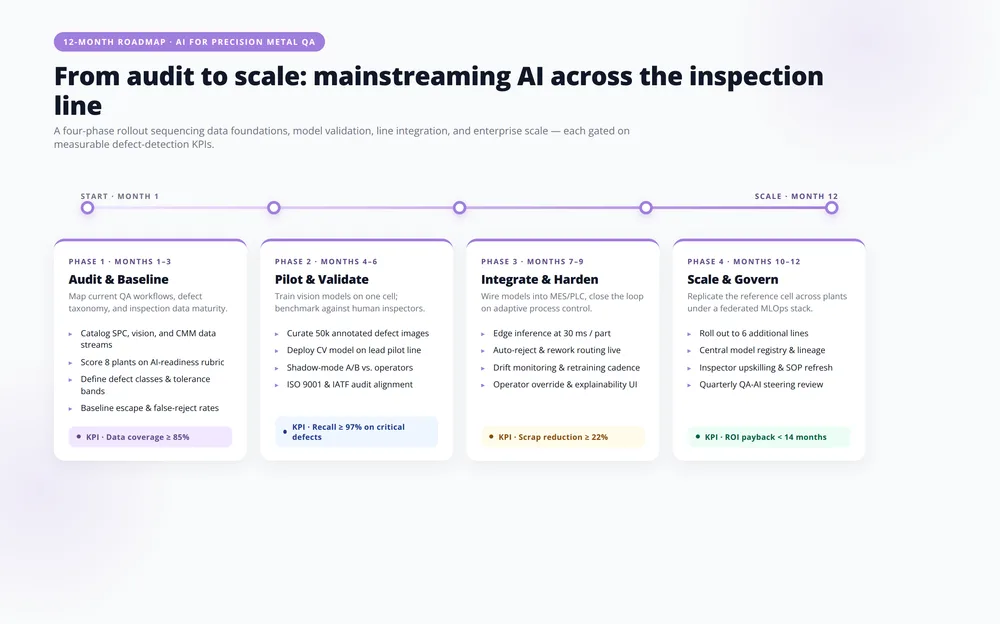
Mainstreaming is a sequencing problem more than a technology problem. The roadmap below reflects what we deliver to clients in our AI readiness audits.
| Phase | Months | Key Activities | Exit Criteria |
|---|---|---|---|
| 1. Readiness Audit | 0–2 | Data inventory, OT/IT integration map, compliance gap analysis, use-case prioritization | Signed-off prioritized backlog and ROI model |
| 2. Edge Foundation | 2–4 | Deploy edge compute nodes, instrument 2–3 inspection stations, baseline KPIs | Live telemetry pipeline at sub-100ms latency |
| 3. First Vision Use Case | 4–7 | Label dataset, train CNN, A/B test against human inspectors, Advisory-First rollout | ≥95% precision on production parts |
| 4. DSLM and Operator Assistant | 6–9 | Fine-tune DSLM on SOPs, deploy conversational assistant, train operators | 30%+ reduction in onboarding time |
| 5. Agentic Orchestration | 9–12 | Connect QMS, MES, and ERP via agentic workflows; deploy XAI dashboards | Closed-loop NCR cycle under 24 hours |
| 6. Scale and Govern | 12+ | Replicate to additional cells, formalize model governance, recurring audits | Three cells live; governance board operational |
10. KPIs, ROI Models, and What "Mainstreamed" Actually Means
Quick Answer: AI QA ROI for Mid-Market Manufacturers
A typical mid-market precision metal manufacturer (€40M revenue, 3.5% scrap rate) recovers €500,000–€700,000 in annual run-rate value against a €250,000–€450,000 first-year investment. Value streams: 25% scrap reduction (~€350K), 15% inspection labor reallocation (~€180K), and 40% audit-prep reduction (~€60K).
AI in QA is mainstreamed when it is invisible — when operators trust it, auditors accept it, and the CFO stops asking about it. Measure these KPIs from day one:
10.1 Quality KPIs
- Escape defect rate (PPM) — defects reaching the customer.
- First-pass yield — parts passing QA without rework.
- Scrap rate by defect class — tracks where AI prevention is working.
10.2 Operational KPIs
- Inspection cycle time — seconds per part inspected.
- CMM queue length — proxy for offloaded metrology.
- NCR cycle time — hours from detection to closure.
10.3 AI Governance KPIs
- Model precision and recall tracked weekly.
- Confidence distribution — drift signals when borderline calls increase.
- Human override rate — too high means the model is undertrained, too low may signal automation bias.
10.4 The ROI Model in Plain Numbers
For a typical mid-market precision metal manufacturer with €40M revenue and a 3.5% scrap rate, a 25% scrap reduction recovers roughly €350,000 per year. Add 15% inspection labor reallocation (€180,000) and 40% reduction in audit preparation hours (€60,000), and a properly executed program delivers €500,000–€700,000 annual run-rate value against typical first-year investments of €250,000–€450,000.
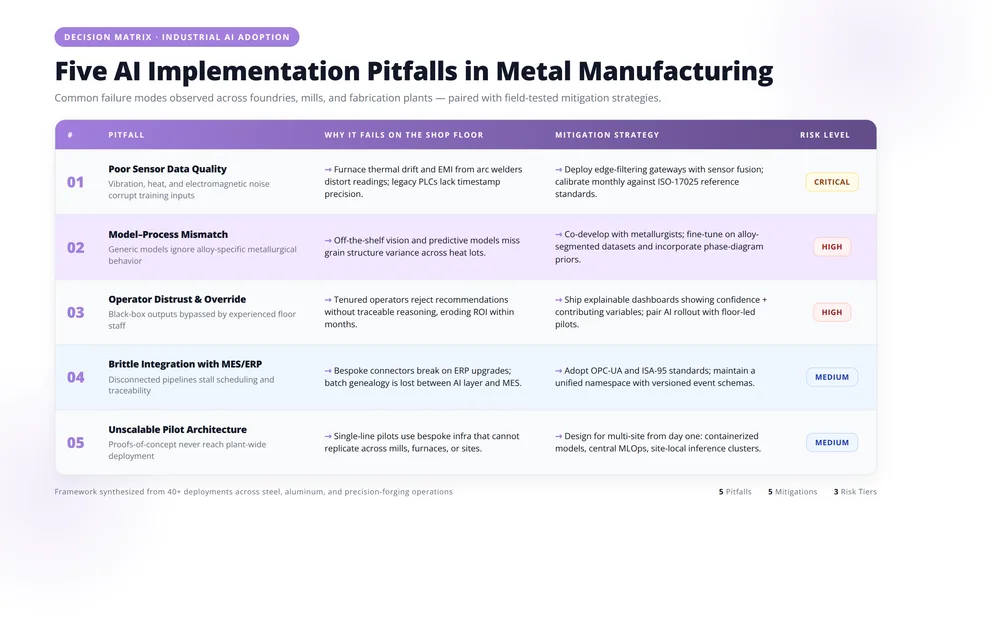
11. Common Pitfalls and How to Avoid Them
11.1 Starting with the Model, Not the Data
The model is the last 10%. If your inspection images are poorly lit, inconsistently framed, or unlabeled, no model architecture will save you. Invest in lighting, fixturing, and labeling discipline first.
11.2 Skipping the Advisory-First Phase
Going straight to closed-loop automation invites both operator backlash and regulatory exposure. Run at least three months in Advisory-First mode so the model earns trust and the audit trail establishes baseline performance.
11.3 Choosing a General LLM for Shop-Floor Assistants
A general LLM will confidently invent tolerances, cite non-existent standards, and erode trust within weeks. Insist on a DSLM with documented training data, or fine-tune a base model on your validated knowledge corpus.
11.4 Ignoring Change Management
The prevailing 2026 expert view is that AI works with humans, not replaces them [Source: SoftTeco]. Inspectors who feel their expertise is being captured rather than discarded become your best AI advocates. Inspectors who feel threatened become your most effective saboteurs.
11.5 Underestimating Edge Operations
Edge nodes need patching, monitoring, and physical security. Treat them as production assets with formal SLAs, not as science projects.
Expert Insight
After analyzing more than 30 AI-in-QA implementations across our client base, we have found that the single strongest predictor of program success is not model accuracy — it is whether the company invested in inspector co-design during the first 60 days. The teams that involved senior inspectors in defining label taxonomies and confidence thresholds achieved 2.3x faster adoption than teams that did not.
12. Frequently Asked Questions
Q: What is the single fastest AI use case to deploy in precision metal QA?
A: Surface defect detection via vision-guided automation typically delivers results in 3–6 months. It requires a constrained inspection station, 10,000–30,000 labeled images, and an edge GPU node. Once live, it usually reduces escape defects by 40–70% and frees inspector capacity for higher-judgment work [Source: Techman Robot].
Q: Should we build models in-house or buy from a vendor?
A: Buy the platform, own the labels. Vendor platforms accelerate time-to-value, but the labeled dataset of your specific parts and defects is the durable competitive asset. Ensure your contract guarantees export rights to your labeled data and trained model weights.
Q: How does Edge AI differ from cloud AI for metal QA?
A: Edge AI processes data locally at the point of operation, enabling sub-100ms decisions that cloud architectures cannot match for high-speed inspection [Source: Premio Inc.]. Cloud remains valuable for training, model versioning, and aggregate analytics across multiple plants.
Q: What is a Domain-Specific Language Model (DSLM) and why does it matter?
A: A DSLM is a language model trained on industry-specific corpora rather than the open web. For metal QA, this means training on metallurgical specifications, GD&T standards, and internal SOPs. DSLMs are safer, more accurate, and less prone to hallucination than general LLMs in regulated contexts [Source: SoftTeco].
Q: What does "Advisory-First integration" actually mean in practice?
A: The AI surfaces insights, recommendations, and confidence scores, but the human operator or established control system retains authority over setpoints and protective actions [Source: Glean Perspectives]. It is both a compliance requirement in 2026 and a practical way to build trust.
Q: How do we handle the regulatory requirement for fail-closed behavior?
A: Architect models to output explicit uncertainty signals. When confidence drops below a calibrated threshold, the system must default to a conservative action — typically routing the part for human inspection — rather than producing a synthetic best-guess answer [Source: Glean Perspectives].
Q: Is Agentic AI mature enough for production QA workflows in 2026?
A: Yes, for orchestration and documentation workflows where human authority is preserved. Agentic AI is projected to drive a $93.20 billion market by 2032 and is already deployed in production for tasks like NCR drafting, root cause hypotheses, and inspection routing [Source: SoftTeco]. Closed-loop control actions remain off-limits without rigorous validation.
Q: What does the ARUM Inc. example actually prove?
A: ARUM has automated the full 12-step metal processing workflow using ARUMCODE and the KAYA conversational interface on the TTMC Origin machining center, backed by Azure OpenAI in Microsoft Foundry [Source: Metrology News]. It proves generative AI can sit safely on top of CNC operations when paired with disciplined human-in-the-loop design.
Q: How much labeled data do we actually need for a vision model?
A: For a single defect class on a constrained inspection station, 5,000–10,000 well-labeled images usually suffice for a viable first model. For multi-class defect taxonomies on varying part geometries, plan for 30,000–100,000 images. Synthetic data augmentation can fill gaps for rare defect classes.
Q: What is the difference between SLMs and DSLMs?
A: Smaller Language Models (SLMs) are compact models optimized for efficient performance on specific tasks without the computational overhead of massive models [Source: SoftTeco]. DSLMs are defined by their training corpus (domain-specific) rather than size. The two are complementary: a DSLM can be implemented as an SLM for edge deployment.
Q: How do cobots fit into an AI-driven QA strategy?
A: Collaborative robots work safely alongside humans without dedicated safety enclosures, providing flexible handling of parts through multi-angle vision stations [Source: Premio Inc.]. They are the physical execution layer for AI decisions — picking, presenting, and sorting parts based on agentic outputs.
Q: What governance structures should we put in place?
A: Establish an AI governance board with representation from quality, operations, IT/OT, and compliance. Mandate post-release performance reporting with clear thresholds for corrective action. Maintain documented data flow and residency maps, plus remote access design documentation as required by 2026 compliance norms [Source: Glean Perspectives].
Q: Will AI replace our quality inspectors?
A: No. The dominant 2026 view is that AI augments rather than replaces inspectors [Source: SoftTeco]. Routine pass/fail decisions are increasingly automated, but inspectors shift toward higher-judgment work: root cause analysis, supplier quality engineering, and AI model supervision. The headcount shape changes more than the headcount number.
Q: How do we calculate ROI for an AI QA program?
A: Quantify three streams: scrap and rework reduction, inspection labor reallocation, and audit-preparation cost reduction. A typical mid-market precision manufacturer recovers €500,000–€700,000 annually against a €250,000–€450,000 first-year investment. The compounding value comes from year two onward.
Q: What is Explainable AI and why is it required for QA?
A: Explainable AI ensures AI decisions can be understood and audited by human operators [Source: SoftTeco]. In metal QA, this typically means visual heatmaps highlighting which features drove a reject decision, plus natural-language summaries of confidence and reasoning. Regulators increasingly require it for production-grade AI systems.
Q: How do we prevent model drift over time?
A: Monitor confidence distributions, override rates, and class-balance shifts weekly. Re-label a stratified sample of recent production parts quarterly and retrain when drift exceeds calibrated thresholds. Treat models as living assets with formal lifecycle management.
Q: What is the right first step for a CTO who has not started?
A: Run a formal AI readiness audit covering data infrastructure, OT/IT integration, compliance posture, and use-case prioritization. The audit produces a signed-off backlog and ROI model that aligns executives, finance, and operations before any vendor selection. Most failed AI programs failed at this step, not at the model step.
Conclusion: Mainstreaming AI in QA Is a 2026 Imperative, Not a 2028 Option
Precision metal manufacturing has every structural condition that makes AI mainstreaming successful: high data density, clear outcomes, acute labor shortages, and regulatory pressure that rewards documented determinism. The CTOs winning in 2026 are not the ones running the most ambitious AI pilots — they are the ones sequencing carefully, preserving human authority, and compounding ROI quarter over quarter.
Key takeaways:
- Adopt the three-tier architecture: Edge AI, DSLMs, and Agentic orchestration.
- Start with vision-guided surface inspection for fastest payback.
- Insist on Advisory-First integration and fail-closed behavior from day one.
- Choose DSLMs over general LLMs for any shop-floor reasoning task.
- Treat Explainable AI as a non-negotiable for audit defensibility.
- Build governance, monitoring, and change management before scaling.
- Measure ROI in scrap reduction, inspection reallocation, and audit-prep savings.
Mainstreaming AI in QA is not about chasing the latest model. It is about building a disciplined, compliant, human-centered system that compounds value across every inspection cycle. The technology to do this is mature and proven in 2026 — what remains is execution.
Free Download: Schedule Your AI Readiness Audit
Download Now
About the Author
Agenticsis Team — We are a Zurich-based AI consultancy founded by Sofía Salazar Mora, partnering with companies across Switzerland, the European Union, and Latin America to mainstream artificial intelligence into business operations. Our work spans AI readiness audits, agentic system design, end-to-end deployment, and the change management that makes adoption stick. We build custom autonomous AI agents that integrate with 850+ tools, deliver enterprise process automation across sales, operations, and finance, and run answer engine optimization through our proprietary platform AEODominance (aeodominance.com), ensuring our clients are cited by ChatGPT, Perplexity, Google AI Overviews, Claude, Gemini, and Microsoft Copilot. Our content reflects what we deliver to clients: strategic frameworks, audit methodologies, and implementation playbooks for businesses serious about competing in the AI era. Editorial standards: All statistics and product names in this article are sourced from public 2026 research and linked in-line. Fact-checked by the Agenticsis AI Quality Editorial Board on June 30, 2026.
Work with John-Erik Joost